.png)
The Agent Is Becoming Wealth Management’s Interface. It Finally Has a Standard
- Simon Alioth
- Jul 9
- 3 min read

By Dr. Simon Alioth, Vice President at OpenWealth Association
At this year’s Point Zero Forum, the OpenWealth Association showcased its OpenWealth Model Context Protocol (MCP) in a live demonstration. On stage, an AI agent queried real portfolios, detected deviations from the client’s strategy, and initiated a rebalancing across custodians, end to end.
The demonstration points to a broader shift. Wealth management is moving towards a new type of interface, the AI agent. At the same time, the Model Context Protocol, originally introduced by Anthropic, is emerging as a standard way for agents to interact with external systems. Building on this, the OpenWealth Association has introduced the OpenWealth MCP to extend these capabilities into wealth management.
Together, these developments signal an important transition. Wealth management is beginning to converge around a shared foundation for what could become its next interface.
For more than two decades, wealth management has been delivered through applications such as client portals, adviser dashboards, and portfolio management systems. These interfaces are designed for humans to navigate data and initiate actions. This model is starting to change. The interface itself is becoming an agent. It is software that can understand an objective, gather information, and act on behalf of the user.
From applications to agents
Today, data in wealth management still moves across custodians, portfolio systems, and client platforms through proprietary interfaces, file transfers, and static documents. This has been manageable because humans bridge the gaps.
A first step towards addressing this fragmentation has been the introduction of standardized connectivity through the OpenWealth API. As illustrated in Figure 1, this phase established a consistent way to exchange core data such as positions, transactions, and client information across institutions.
This foundation is critical for the next step. Agents change the equation. An agent that must connect to every institution through a different interface, format, and security model cannot scale and increases the risk of acting on incomplete or outdated data.
The Model Context Protocol provides a standardized way for agents to interact with external systems. Building on both MCP and the OpenWealth API, the OpenWealth MCP extends this approach to wealth management. As shown in Figure 2, it enables agents to access data and services across institutions through a single, standardized interface.
For agents to work reliably, they require consistent and trusted access to both data and services. This is not a marginal improvement. It is a structural requirement.

Figure 1: The evolution of custody-banking connectivity
Why standards matter now
Data standards are no longer a technical detail. They are becoming a strategic enabler. The OpenWealth API standardizes core domains such as positions, transactions, customer data, and trading, creating a consistent foundation across institutions.
MCP adds a complementary layer. It allows agents to discover services, request permission-based access, and perform actions in a governed way. The OpenWealth MCP aligns these capabilities with wealth management processes and data models.
In practical terms, institutions can expose their capabilities in a consistent and secure way, with authentication, client consent, and auditability embedded in each interaction. Fragmentation is reduced and integration becomes simpler.
As a result, connectivity itself becomes less of a differentiator. The focus shifts towards the quality and reliability of the services built on top of it.
The end of the banking app and the evolving role of advisers
From the client perspective, this shift fundamentally changes how financial services are accessed.
Instead of using multiple banking applications, a client could rely on a single trusted agent with permission-based access to data and services across institutions. Control remains with the client, who defines what the agent can access and do. The experience evolves from isolated applications to a more unified and client-driven model.
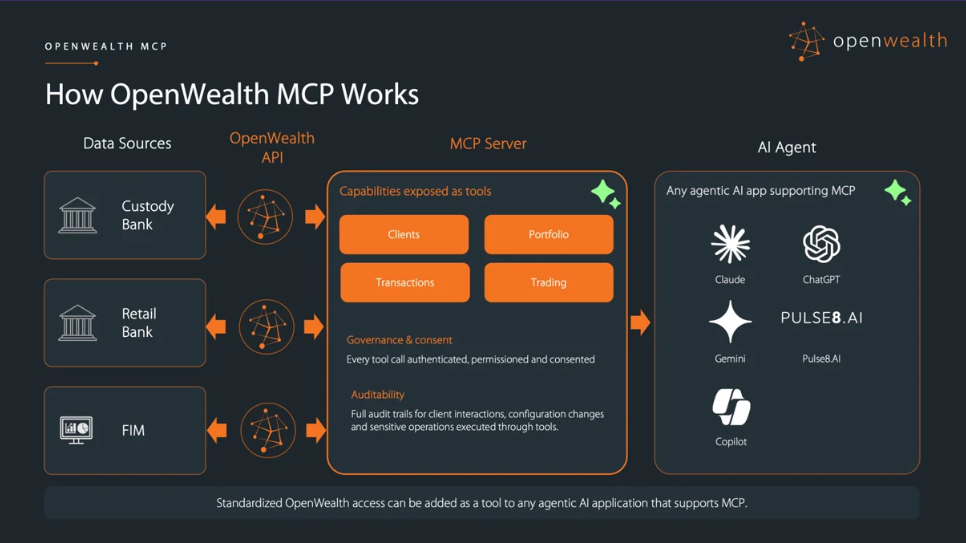
Figure 2: How the OpenWealth MCP works
At the same time, this does not eliminate the role of the human adviser. It reshapes it. Agents are well suited for repetitive and data-intensive tasks such as monitoring portfolios and identifying potential adjustments. Advisers remain essential for judgement, long-term planning, and relationship management.
The result is a hybrid model in which agents and advisers complement each other. Early use cases are likely to focus on insights, alerts, and guided actions with human oversight.
An open invitation
By introducing the OpenWealth MCP and committing to its open-source development, the OpenWealth Association is providing the industry standard for the next wave. The infrastructure for agent-based wealth management should be built collectively by the industry.
The transition to agent-based interfaces is underway. With a shared foundation now emerging, the conditions for scale are taking shape.
The key question is no longer whether the interface will change. The question is who will help define how it works.


